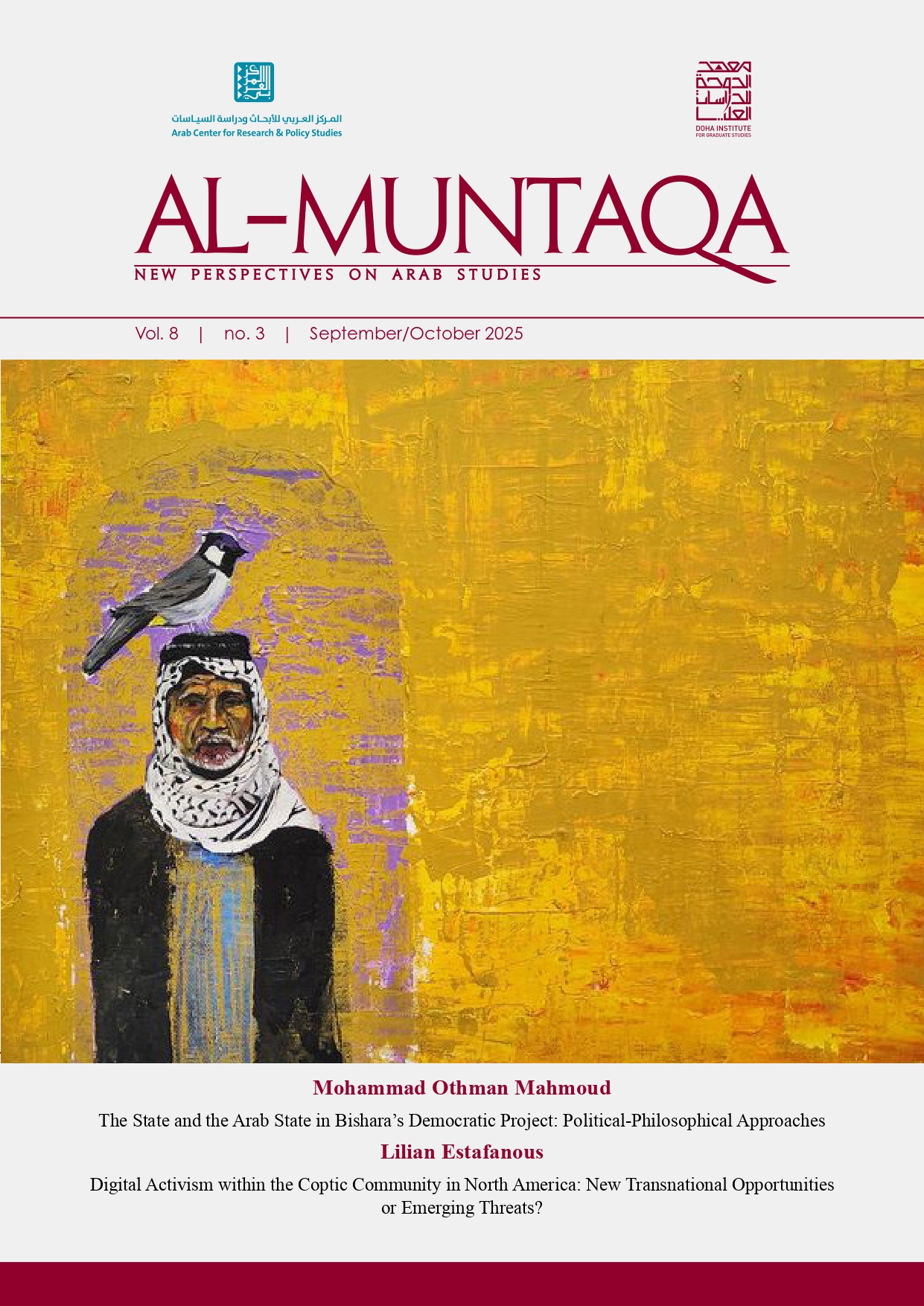
 The Arab Center for Research and Policy Studies and the Doha Institute for Graduate Studies have published Issue 20 (September/October 2025) of the peer-reviewed English language journal Al-Muntaqa: New Perspectives on Arab Studies. The collection brings together four studies that examine pressing issues on digital activism, state theory, religious economy, and pharmaceutical practice. It also features two book reviews.
The opening study, “The State and the Arab State in Bishara’s Democratic Project: Political-Philosophical Approaches” by Mohammad Othman Mahmoud, examines the question of the state in Azmi Bishara’s exploration of democracy through the lens of political-philosophical approaches to utopia, Rawlsian philosophy, citizenship, civil society, and justice. The study demonstrates how Bishara develops a theory of the state and elaborates it conceptually, treating the state as a realistic political utopia.
In “Digital Activism within the Coptic Community in North America: New Transnational Opportunities or Emerging Threats?”, Lilian Estafanous examines the dual impact of digital technologies on the political agency of the Coptic diaspora, emphasizing both the opportunities and limitations posed by Information and Communication Technologies. The study argues that the drawbacks of digital activism now outweigh its initial benefits, creating new constraints on Coptic political influence.
Mehdi Mabrouk’s “The Illusion of the Tunisian Exception: Civil Society and Democratic Transition” deconstructs the narrative of Tunisia as a democratic outlier. It demonstrates how civil society contributed to the derailment of democratic consolidation by exacerbating Islamist-secular divides, aligning with political parties, and encroaching on the functions of the state, culminating in the 2021 presidential coup.
The article, “Economic Theology in Iraq: The Parallel Economy of Al-Kafeel” by Khalid Mutlaq explores the rise of “economic theology” in Iraq through an examination of the Shi’i Al-Kafeel network and its expanding institutional presence. It addresses the central question of how religious authority, when disengaged from state structures, constructs a parallel economy grounded in theological legitimacy and moral purpose.
In “Toward a Pharmaceutical Anthropology in Morocco: The Biography of Aureomycin from Physical Production to Cultural Reinterpretation”, Farouk Tahri traces the life story of Aureomycin in Morocco from its initial introduction, through physical production, marketing, and distribution, to consumption. He shows that the medicine had not been used as its producers had anticipated. Rather, it has been subject to the logic of “pharmaceutical heretics” who treat Aureomycin as a folk remedy and integrate it into a new, intermediary treatment process that is neither fully modern nor wholly traditional.
The issue features Jerusalem Story’s graphic on how Israel restricts local Muslim’s access to worship in al-Aqsa Mosque, which offers a visual overview of the multilayered points at which Israel blocks Muslims from accessing their holiest site, even during Ramadan.
The collection concludes with two book review essays. Brahim Chlaih reviews The 2019 Legislative and Presidential Elections in Tunisia: Politics, Electoral Behaviors, and Elite Mobilization and Yasmine Lahnin reviews Anas Khaled Nassar’s Chinese Strategy Toward Arab States: Goals and Implications for the Future, an Exploration.
