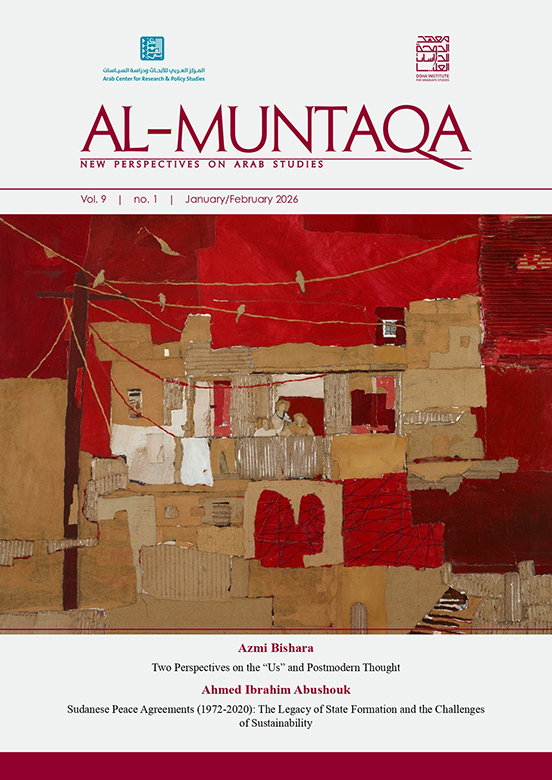
 The Arab Center for Research and Policy Studies and the Doha Institute for Graduate Studies have published Issue 21 (January/February 2026) of the peer-reviewed English language journal Al-Muntaqa: New Perspectives on Arab Studies. The collection brings together five studies that examine postmodern critique, state formation, water governance, settler-colonial economy and space, and voter turnout. It also features an Arab Opinion Index analysis and two book reviews.
The opening study, “Two Perspectives on the “Us” and Postmodern Thought” by Azmi Bishara, examines the implications of importing postmodern thought into a non-Western context, arguing that postmodern claims on the relativity of truth, the deconstruction of grand narratives, the transcendence of the authority of universal reason, and scepticism toward human agency are grounded conditions of Western modernity that remain absent in partially modernized societies.
In “Sudanese Peace Agreements (1972-2020): The Legacy of State Formation and the Challenges of Sustainability”, Ahmed Ibrahim Abushouk analyses the roots of conflict between the political centre and peripheral regions, drawing on the concept of the legacy of state formation and arguing that, since the colonial period, central state policies have concentrated development and power in the riverain provinces at the expense of other regions. Several peace agreements have, however, failed to address the fundamental causes of conflict.
Youssef Dahraji’s “Public Right or Economic Commodity? The Evolution of Water Policy in Jordan and Morocco” argues that water management policies in Jordan and Morocco have functioned as strategic instruments, leveraged to impose territorial control and reinforce political authority. Using a comparative analytical approach, the study traces the evolution of dam policies, privatization choices, and the role of international financial institutions in governing this vital resource.
The article, “The Cost of Israeli Settler-Colonial Occupation on the Palestinian People” by Mahmoud Elkhafif, Raja Khalidi, and Tareq Sadeq explores the economic cost borne by the Palestinian people as a result of the Israeli occupation of Palestinian territory, covering the period 1948-2022. It advances three methodologies for such an assessment: aggregation, counterfactual estimation, and occupation gains.
In “Mapping the Israeli Settlement Project in the West Bank: History and Institutions”, Walid Habbas and Anmar Rafeedie trace the various components of the Israeli settlement project in the West Bank, as well as the Israeli agencies and institutions that plan, implement, and support it. They argue that the settlement project constitutes an integrated structure engaged in a conflictual relationship with Palestinian space, governed by a zero-sum logic.
The Arab Opinion Index Analysis section features Abdelkarim Amengay and Yasmine Lahnin’s “Individual Motives and Voter Turnout in the Arab World: What Role Does Perceived Regime Democracy Play?”, which examines how citizens’ assessments of the level of democracy in their political system shape their likelihood of voting. They analysed data from the eighth Arab Opinion Index using binary logistic regression.
The collection concludes with two book review essays. Mohamed Oubella and Mohamed Salmi review Salem Ouakari’s The Manufacturing of Belonging: A Study of Land Ownership in the Sahrawi Community (the Ait Oussa Tribes 1600- 1958) and Khatri Elayachi reviews Ghazza Abderrazzak’s The Conceptual and Technical Foundations of Artificial Intelligence and Its Evolution: From Computational Models to Machine Learning.
