I.B. Tauris/Bloomsbury Publishing has published Azmi Bishara’s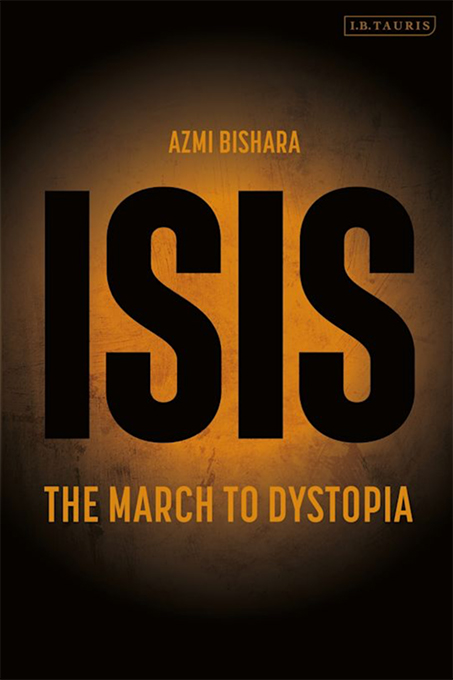 ISIS: The March to Dystopia, the most comprehensive study of ISIS to date. An adaptation of a book first published in Arabic by the Arab Center for Research and Policy Studies, the book benefits from Arabic sources previously unavailable to an English-speaking audience. It traces the emergence, trajectory, and transformations of the Islamic State Organization within its historical, social and political context. In doing so, Bishara shifts the focus from Salafi ideology as an explanatory framework for its rise and expansion by connecting the rise of ISIS to social and political historical developments including the history of ideas, sectarian politics, the outbreak of civil war in Iraq and Syria and the decline of the central state.
How can we understand ISIS today? The book breaks the question down across six chapters that analyse its intellectual roots, organizational evolution, conditions of expansion, governance practices, and ideological foundations. The introduction and first chapter offer a critical review of the existing literature on ISIS, distinguishing scholarly contributions from politicized, sensationalist, or ideologically driven accounts. The study then interrogates how ISIS should be categorized: as a jihadi-Salafi movement, a rebel organization, a civil-war actor, and a hybrid product of state collapse and ideological extremism. Bishara argues that neither Salafism nor experiences of state repression alone can explain the rise of ISIS. Rather, diverse psychological and social factors, including the trauma of prison, sectarian exclusion, and the appeal of moral “catharsis”, shaped individual trajectories into radicalization, while some ISIS elites genuinely believed in the organization’s ideological project. The analysis stresses that ISIS’s ascent cannot be understood without reference to sectarian politics, state failure, and the fragmentation of Iraq and Syria. ISIS did not merely combine al-Qaeda’s transnational jihad with Taliban-style state-building; nor did it establish a state in any meaningful sense. Instead, its expansion depended on exploiting ungoverned spaces, war, and the erosion of central authority.
Chapter Two traces the conceptual evolution of the modern ideology of jihadism. It highlights how contemporary jihadi movements, including ISIS, diverge sharply from classical understandings, participating instead in a broader ideological field marked by cooperation, rivalry, and schism. Jihadi Salafism is deeply fragmented, with persistent internal disputes, including mutual accusations of heresy among rival groups.. The third chapter analyses ISIS’s differentiation from al-Qaeda, mapping the doctrinal and strategic disputes that fractured the jihadi milieu. Points of tension included the treatment of Shi‘a civilians, the permissibility of excusing unbelief on grounds of ignorance, and the legitimacy of declaring a state. These disagreements were tightly bound to struggles for authority, hegemony, and control of the broader Islamist field.
Chapter Four examines the crisis of the Arab state and shows how ISIS’s expansion drew primarily on the weakness of state institutions rather than the organization’s inherent strength. The US occupation of Iraq, sectarian governance, and the resurgence of tribal and sectarian identities created fertile ground for the emergence of figures such as Abu Musab al-Zarqawi and later Abu Bakr al-Baghdadi. ISIS’s resources (oil revenues, taxation, smuggling, and extortion) were structurally tied to territorial expansion and war. Chapter Five explores life under ISIS, rejecting the assumption of an inherently supportive Sunni environment. Instead, communities either fled or complied out of coercion and economic need. ISIS governance relied on extreme brutality, the reduction of Sharia to punitive measures, and totalitarian control over education, daily life, and public morality.
The final chapter analyses ISIS’s ideological corpus and its selective appropriation of religious texts. It demonstrates that ISIS’s “new jihadism” is intellectually shallow, constructed from decontextualized citations aimed at monopolizing Islamist legitimacy. Ultimately, the book argues that ISIS represents a distorted product of the crises of the modern Arab state and of Islamic thought, and that critiquing ISIS necessarily opens a wider critique of contemporary Islamist movements and the intellectual impasses within Arab political thought.
